
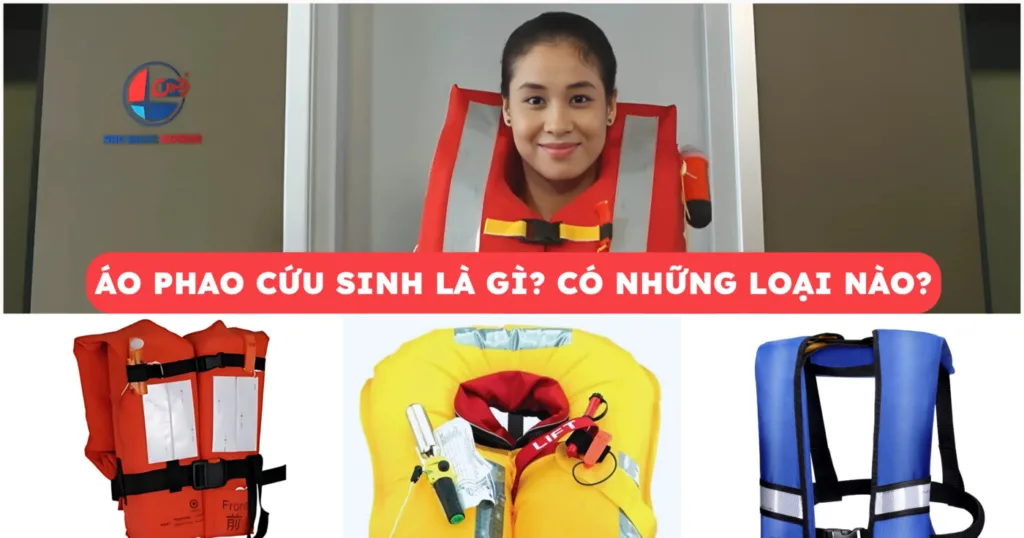
Sea travel opens up a vast view, taking visitors across the waves to reach beautiful islands. Along with that beauty comes the responsibility to proactively protect the safety of yourself and the community. On every voyage, life jacket is the number one priority equipment because it directly protects lives in unexpected situations. Phu Quoc Express high speed boat Connecting the mainland with Phú Quốc, Côn Đảo, Phú Quý... has built a synchronous safety system, combining standard equipment, strict procedures and regularly trained staff. Thanks to that, every trip of domestic and international tourists becomes safe, complete and memorable.
What is a life jacket?
Life jacket is an essential personal protective equipment, made with specialized materials that help the wearer's body automatically float on the water, playing a key role in preventing drowning and ensuring safety in water activities or emergency situations. The automatic buoyancy mechanism is the difference between life and death, helping to maintain the airway even when the victim is panicked or unconscious. Thanks to that, the vest becomes a hope for survival, turning a dangerous situation into a controllable incident.
Classification of life jackets
Life jackets are equipment maritime safety important, mandatory on board ship according to SOLAS Convention (Safety of Life at Sea). There are many types of life jackets classified based on purpose of use, design and technical standards. Below are details on each type, including specifications, buoyancy, flipping ability, suitable subjects and usage situations.
Classification by purpose of use
- Life jackets for adults: Designed for adults (usually over ~32–40 kg depending on the standard). Adult life jackets must have enough buoyancy to support the head of an unconscious person. at least 120 mm on the water and rotate the person lying on his back in a circle 5 seconds. Adult life jackets typically have a nominal buoyancy of ~150N (equivalent to lifting ~15 kg) to keep you safe even when wearing thick clothing. This is the standard life jacket fitted on ships and large boats, allowing the wearer to jump into the water from a height of ~4.5 m without damaging the jacket. Every international passenger ship must have enough life jackets for all adults on board, including large sizes for people weighing up to ~140 kg (with extension fittings if needed).
- Life jackets for children: A miniature version of an adult life jacket, used for children (usually under ~32 kg). Children's life jackets have neck support (neck cushion) relatively larger, helping the baby's head float upside down on the water. Many models also have crotch strap through the legs and the strap behind the neck to prevent it from slipping off the child. The minimum buoyancy is usually 100N for children. Children's life jackets are made of buoyant foam so that they are always ready (inflatable ones should not be used by children as the mechanism may malfunction). According to international recommendations, on passenger ships, the number of children's life jackets must be at least 10% per total number of passengers, and there must also be one for infants if there are children under 1 year old. Note: Always choose the right life jacket weight and height child's, ensuring a snug fit that does not slip over the chin when floating.
- Life jackets for people who cannot swim: Poor swimmers or those who cannot swim should use “real life jacket” not just buoyancy aids. The most suitable type is a life jacket. ≥100N Has a collar to help the wearer flip over. Shirt 50N (for sports) Are not safe enough because Unable to keep unconscious person face upTherefore, people who cannot swim should wear a swimsuit. 100N or more, preferably a 100N foam life jacket with a head-lift collar, which “will turn most wearers, especially children,” in still water. The 100N life jacket, although a bit bulky, is well suited for weak swimmers, elderly people, boat passengers on rivers, lakes or coastal areas. For those who cannot swim in open sea or bad conditions, a standard 150N jacket (see below) should be used to ensure maximum safety.
Classification by design
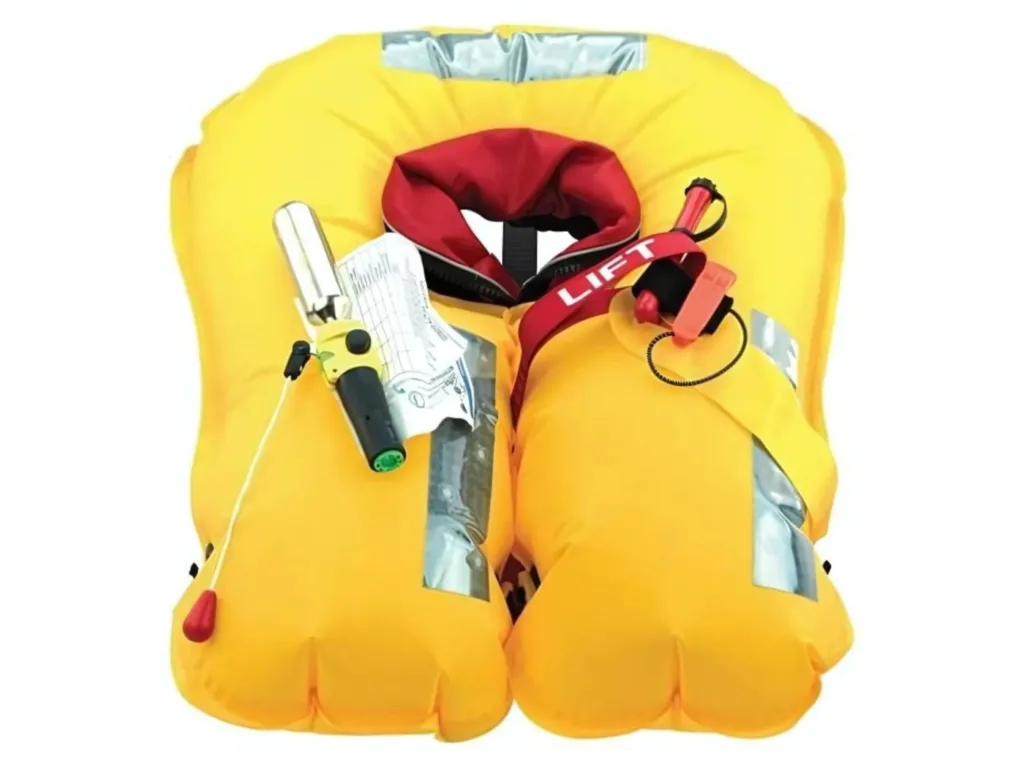
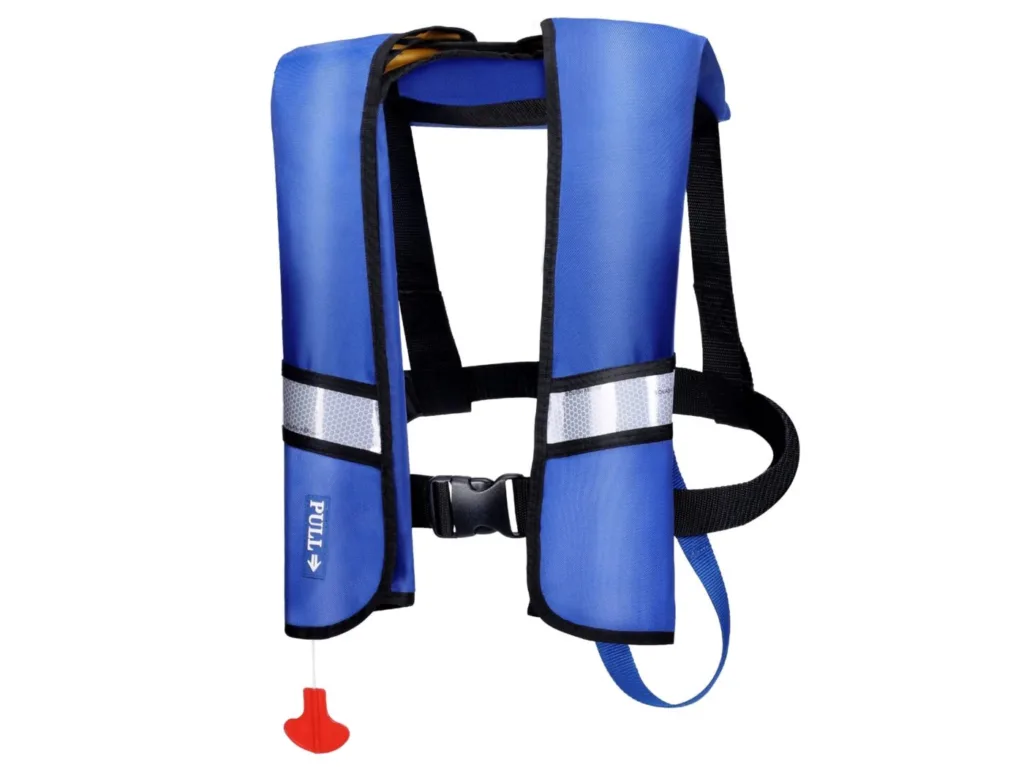
- Inflatable life jacket (self-inflating): This type of life jacket uses CO₂ gas cylinder to inflate when needed. There are two main types of activation: automatic (The airbag will inflate automatically when the jacket comes into contact with water thanks to the water sensor mechanism) and handmade (The wearer must pull a string to inflate the vest.) Additionally, all inflatable vests come with a spare mouthpiece for inflating with air if needed. Advantage: Very compact design, does not hinder movement - when not inflated, the shirt is as soft and thin as a belt or a thin vest. Inflatable shirts usually have high buoyancy (commonly 150N, even 275N) so when inflated, they provide high buoyancy and better head lift than foam shirts. Disadvantages: depends on the pump mechanism, so requires regular maintenance and periodic inspection (replace activator, gas cylinder). If the mechanism inactive or user unconscious without pulling the strings (with handmade type) the shirt will be no pump and no effect. So, inflatable vest suitable for adults to operate, usually sailors, crew members, yachters... who need to wear the shirt for a long time but still be comfortable. Note that inflatable jackets should not be used for children or people under ~16 years old, and should not be used when playing jet skis or surfing (because they can easily be activated by mistake).
- Buoyancy material life jacket (buoyancy foam): These are life jackets used light material with self buoyancy (like PE foam, PVC) to float, No inflation required. The shirt is always ready for buoyancy (passive activation) – just wear it properly and it is safe, no mechanism can fail. Advantage: very trust because it is not dependent on technology; enduring (simple maintenance, just wash and dry after use); long-term use without worrying about structural damage like inflatable vests. Floating foam vests also better protection in cold water or impact (many models used in speed sports have additional shock absorbers). Disadvantages: rather voluminous, thick around the body so limited movement than inflatable vests. The buoyancy of foam vests depends on the thickness, usually fixed (50N, 100N or 150N per adult vest). This type Ideal for children and beginners because they stay afloat even if they don't know how to activate the vest. On marine vessels, traditional SOLAS life jackets are also buoyant foam to ensure performance in all situations.

- Collared life jacket (head-lifting collar): This is the design classic of life jackets, with neck loop and pad large band at the back of the neck to support the head above water. The shirt is usually shaped like a "punch hole" (keyhole) passes through the head, covers the chest and has a strap around the waist. Advantage: This design is optimized for face up When floating – most of the buoyancy force is concentrated in the chest and behind the neck, which will automatically turn the body from face down to face up. Disadvantages: It's a bit difficult to wear incorrectly (because there's only one correct way to wear it) but it's also bulky, uncomfortable to wear for long due to the large collar. SOLAS life jackets on ships are usually of this type (bright orange, with reflective tape, whistle and lights) for use in emergencies. Many models 100N foam for kids also has a halter neck, with additional crotch straps and supporting handles. The halter neck shirt is suitable for non-swimmer and emergency life-saving situations, but not convenient for everyday sports activities.
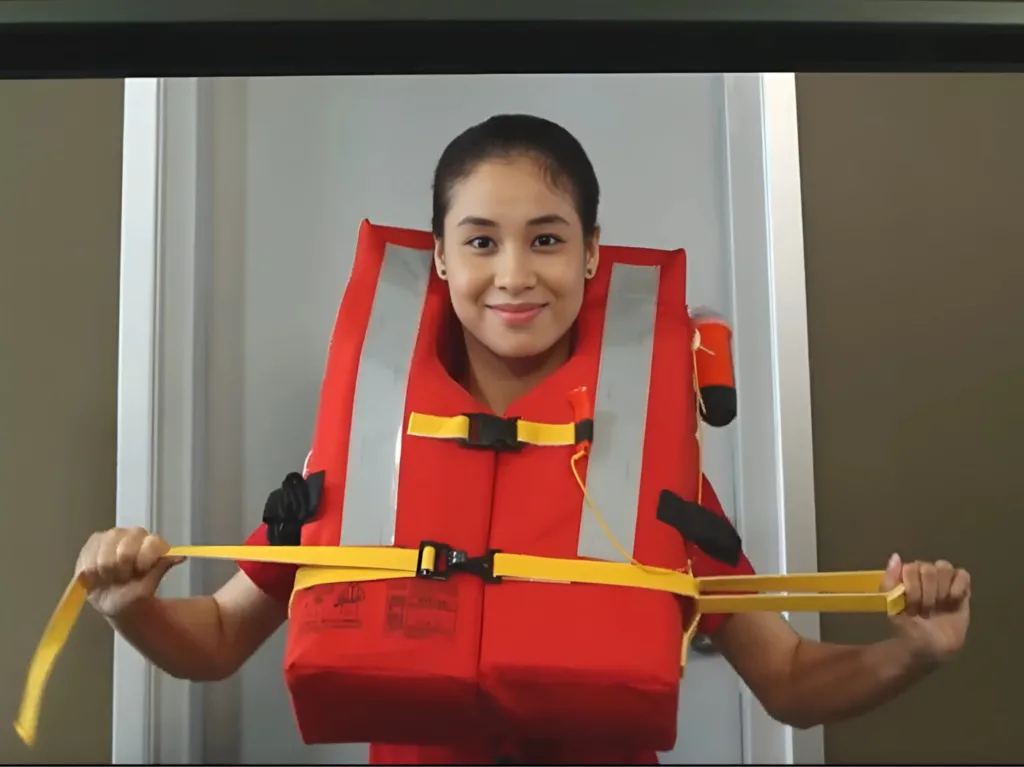
- Vest-style life jacket: Is a life jacket worn like a vest worn over the shoulder, around the chest, often with front straps. This design is popular in 50N buoyancy aid vest used in water sports (rowing, kayaking, jet-skiing…) by neat and flexible than the halter neck style. The vest may not have as much neck padding, so less head support more – 50N or 100N vest almost no guarantee of flipping unconscious person. Some 100N vests have a little neck lift but still tends to be comfortable for swimmers. Advantage: Easy to wear, no tangles, suitable for continuous activity on the water. Disadvantages: Not safe for unconscious or non-swimmers (unless equipped with a head support collar). According to Canadian classification, small boat life jacket There are two main models: "old style" (keyhole) and "vest style" – Users should choose according to their needs: vest for convenience, halter neck for higher safety.
Classification according to international standards
To ensure quality and functionality, life jacket must meet the technical standards. Below are the main standard systems and related classifications:
- SOLAS Standard (IMO): SOLAS is an international convention on Safety of life at sea issued by the International Maritime Organization, applicable to international passenger and cargo ships. SOLAS standard lifejackets must comply with “Life-saving appliances code” (LSA Code). Main requirements include: ability to turn quickly (≤5 seconds) unconscious person, hold mouth of floating person Minimum height 12 cm above water level, no loss of buoyancy over 5% after 24 hours of immersion in waterEach garment must withstand a flame for 2 seconds without on fire next, allowing the wearer to jump from 4.5 m without slipping off the shirt, and supporting the wearer to swim a short distance to self-rescue. Regarding equipment, SOLAS shirt required attachment whistle, reflective tape and flashing life light (white light ≥0.75 cd continuously ≥8 hours). SOLAS life jackets come in two sizes: adult (>32 kg) and children (≤32 kg); passenger trains must also have jackets newborn for children <1 year old. Many traditional SOLAS shirts are made of foam (foam) with buoyancy of ~150N (enough to float a 140 kg person). There is also a SOLAS vest two chamber pump (2 independent air tanks) for backup when one chamber deflates – this type usually provides high buoyancy 275N to suit extreme conditions. All SOLAS lifejackets on ships ≥500 GT must carry the IMO/EU “Wheelmark” (MED).
Note: Above high speed train passenger transport (as per HSC Code), requires SOLAS equivalent life jackets, are readily available to passengers, and are generally recommended to be used compact so that passengers can quickly put on in an emergency.
- Standard ISO 12402 (CE): This is the set International standard for life jackets and personal flotation devices widely used for recreational and coastal vessels. ISO 12402 divides life jacket according to buoyancy force level (Newton), corresponding to the European standard (EN) before and may have signs CE when circulating on the EU market. The main levels include: 50N, 100N, 150N and 275N, with the following summary characteristics:
|
Life jackets |
Nominal buoyancy | Features & Flip Ability |
Object & Environment of use |
| 50N (Level 50) – Floating support vest | ≥50 N (≈5 kgf) | Life jacket for swimmers, no auto-tilt guarantee unconscious person. Lightweight design, usually vest-like, for high freedom of movement. | good swimmer, calm water near shore (water sports: kayak, SUP, skateboarding…). Not suitable for non-swimmers or offshore environment. |
| 100N (Level 100) – Basic life jacket | ≥100 N (≈10 kgf) | Life jacket head support, average buoyancy. Can be rotated people in still water (especially effective with children) but limit in big waves or when wearing heavy clothing. | Inland, coastal, river and lake – for people waiting for rescue protected waters. Suitable for children, people who can't swim Use on cruise ships, small yachts, nearshore operations. Not recommended for rough seas. |
| 150N (Level 150) – Offshore life jackets | ≥150 N (≈15 kgf) | Life jacket standard offshore. Designed to self-turned most unconscious people (even when wearing light rain gear). Usually comes in a automatic air pump very compact, or thick foam. | Offshore, bad weather conditions – shared ship, sailboat, fishing boat and all offshore purposes. This is the level mandatory minimum standards for international maritime operations (SOLAS) For adult shirts. Popular for sailors, fishermen, and ship drivers who have to wear them for long periods of time. |
| 275N (Level 275) – Specialized life jackets | ≥275 N (≈28 kgf) | Life jacket performance very high, ensure flip over fast unconscious people wearing full protective gear. Most of them Dual chamber inflatable vest (SOLAS compliant), slightly bulkier when inflated. | Ocean, harsh conditions – for professional crew, rig crew, rescue boat, ocean race… or people wearing bulky thermal clothing, carrying heavy tool belts. This is also the standard for SOLAS inflatable life jacket on passenger ships and ocean liners today. |
- Note: ISO 12402-5 corresponds to level 50N, ISO 12402-4 to 100N, ISO 12402-3 to 150N, and ISO 12402-2 to 275N. Life jackets that meet ISO standards usually have the mark CE on the label – CE marking (mandatory in the EU) confirms the life jacket meet safety requirements basically according to European regulations. In other words, CE mark or Wheelmark on the life jacket is proof of having passed the test according to the standard (ISO or SOLAS respectively). The user should check the life jacket label to know what class it belongs to and whether it is suitable for his/her intended use.
In short: Understanding the different types of life jackets based on their function and design will help you choose the right type for each individual and situation. On ships and speedboats passenger transport, international law (SOLAS, HSC Code) requires equipment life jacket must be standard for everyone on board, including children and spares. For recreational or water sports activities, users can choose from life jacket floating support or life jacket ISO standards are appropriate, but remember safety first: people who can't swim or go to sea far away must use life jacket (halter neck style) with head-lift collar and high buoyancy and All Phú Quốc Express High Speed Boats are equipped with this type of life jacket according to international maritime safety standards (SOLAS)..
Why are life jackets indispensable on sea journeys?
In marine environments, weather can change very quickly. Life jacket provide buoyancy to help the body stay afloat, keep the airways clear and limit heat loss. Bright colors with reflective strips, sirens or flashing lights help rescue teams easily detect in poor visibility conditions. For children, the elderly and people who cannot swim, the protective effect of life jackets becomes even more important. In fact, wearing life jackets correctly shortens reaction time, creating conditions for crew members to organize an orderly evacuation and access to collective lifeboats. When each passenger understands and complies with the instructions on life jacket, the risk in unexpected situations will be significantly reduced and the chance of safety will be significantly increased. Accordingly, Phú Quốc Express gives you some notes as follows:
Safety standards: from national regulations to onboard practice
Vietnamese law on life-saving equipment on ships (QCVN 42:2015/BGTVT), passenger ships are required to provide standard personal life jackets for all passengers and crew, and to provide children's life jackets in accordance with the prescribed ratio. Each life jacket must have clear symbols and instructions for use, and be placed in an easily accessible location. In addition, there must be lifebuoys, inflatable life rafts, signal devices, fire protection systems, escape plans, and emergency assembly areas. On board Phu Quoc Express high speed boat, the pre-departure inspection process always includes checking life jacket compartments, signs, emergency exits and the operational status of communication equipment. This uniform compliance ensures that each ship leaves port in the best condition, ready to respond to emergency scenarios according to standardized procedures.
Life jackets on Phú Quốc Express speedboat: synchronous and exceeding standards
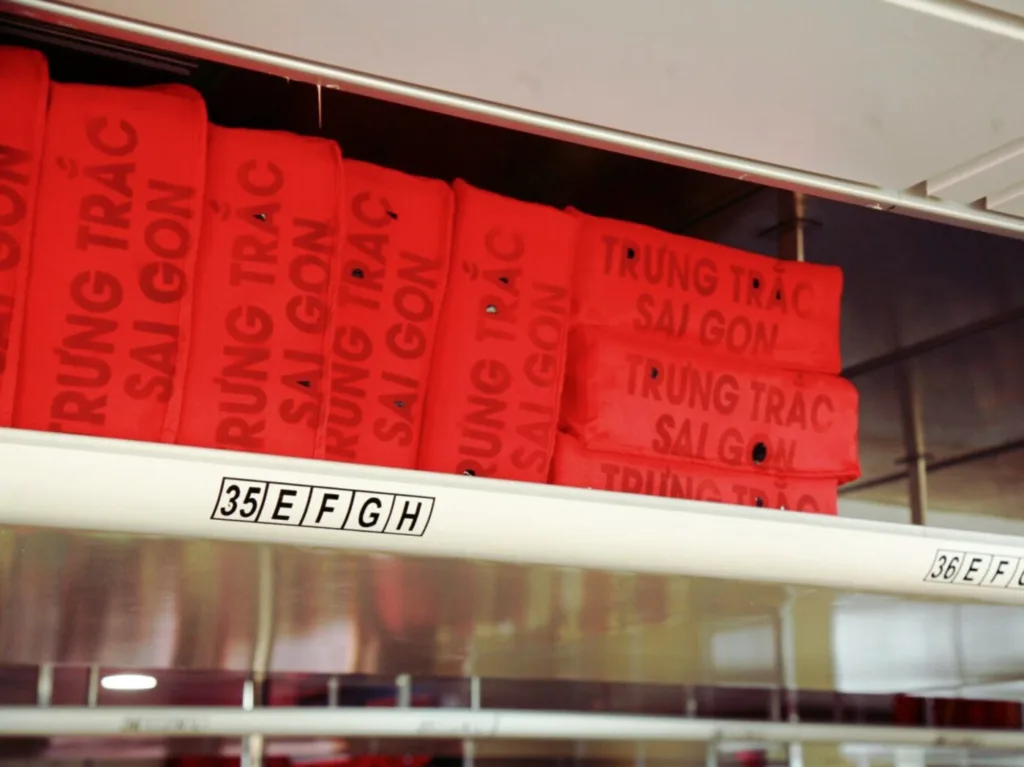
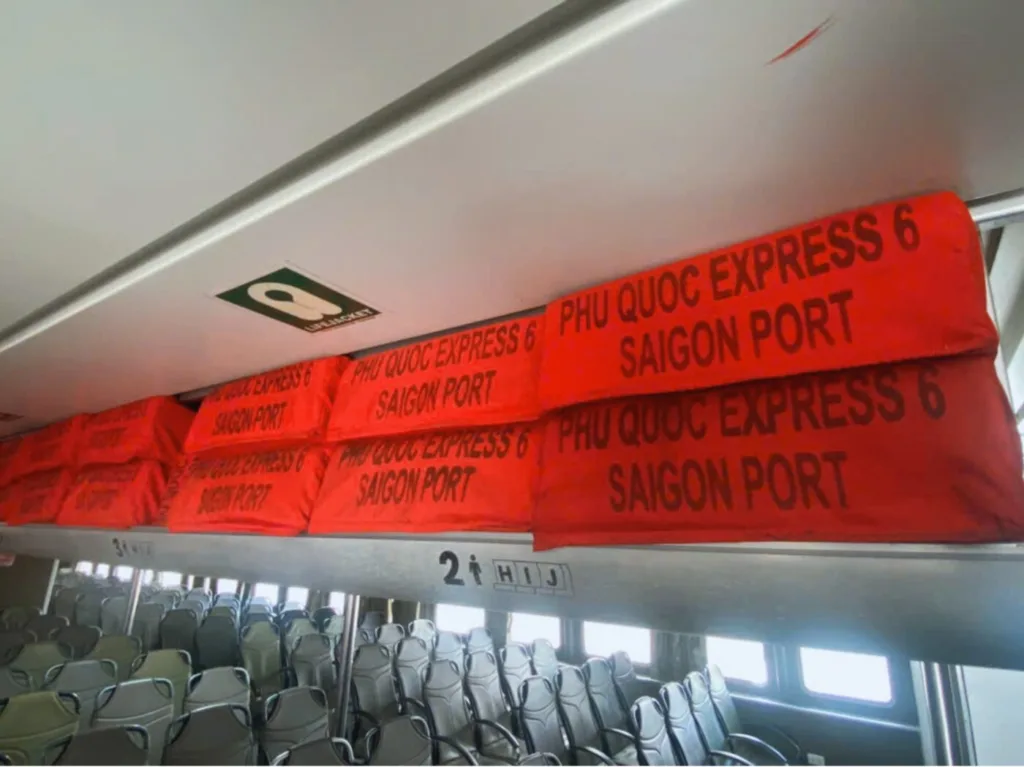
Strengths of Phu Quoc Express high speed boat lies in the synchronization. Each passenger has a life jacket with brief operating instructions. The airline maintains more spare life jackets than seats to meet the needs of unexpected situations, and clearly classifies adult and child sizes. Staff regularly remind passengers to locate their life jackets as soon as they are seated. In addition, self-inflating life rafts are arranged in balance on both sides, integrated with a quick-release mechanism, allowing for safe mass evacuation in a short time. All of this is to ensure that, regardless of the circumstances, passengers can still access life-saving equipment at the right time, in the right way, with a high level of reliability.
Basic structure of modern life jacket
One life jacket Standard life jackets typically include a closed-cell foam core or airbag, a durable, salt-resistant shell, reflective strips, a whistle, a flashing light that activates when exposed to water, and a sturdy strap and buckle. The design prioritizes the ability to keep the head above water and limit capsizing. In the children's version, the neck is reinforced to better support the head, reducing the risk of choking. Details such as seams, adjustment buckles, and reflective strip placement are all tested to withstand impact and pulling in emergency situations. Thanks to its safety-oriented structure, life jackets help the wearer conserve energy, maintain consciousness, and easily attract the attention of rescuers.
Instructions on how to wear a life jacket properly
- Step 1: Take the life jacket from the compartment near the seat, quickly check the straps and buckles.
- Step 2: Put the shirt over your head or arms depending on the model, placing the collar in the correct position.
- Step 3: Fasten the buckles in order and tighten the straps so that the vest fits snugly, but is still comfortable to breathe in.
- Step 4: Check horn, reflector strip and flashing lights (if equipped).
- Step 5: Assist children, the elderly, pregnant women or people in difficulty first; then the remaining passengers.
- Step 6: Listen to crew instructions on order of movement to the assembly area.
- Step 7: In all situations, stay calm and observe the signs.
For those who have never used it life jacket, familiarizing yourself with the operations as soon as you board the ship will save valuable time in case of an emergency.
Common mistakes when using life jackets and how to fix them
Common mistakes include choosing the wrong size, tightening the belt too loosely or too tightly, missing a buckle, carrying a heavy bag when it falls into the water, activating the airbag while still on the boat (for inflatable vests), or wearing the life jacket the wrong way around. To avoid this, take a minute to read (watch a video) the instructions and observe the illustrations, then cross-check with your companion. On Phu Quoc Express high speed boat, staff are always ready to help and will remind in Vietnamese and English when they notice incorrect operations. Simple practice before departure helps improve the safety of the entire cabin, creating conditions for the evacuation process to take place quickly and orderly.
Prepare before the trip
- Locate life jacket near and above your seat.
- Read or quickly watch the life jacket wearing instructions (video).
- Observe the nearest exit and assembly area location.
- Keep luggage neat and out of the way.
- Listen carefully to the safety announcement before leaving the dock.
These simple habits shorten the response time in case of an incident, and at the same time create the necessary order for the crew to guide the movement quickly and effectively. Passengers traveling in groups should agree on a meeting point at the assembly area to avoid getting lost in an emergency, especially when children are traveling with them.
Proactive safety from the team and operating procedures
Modern equipment only works best when accompanied by people and processes. The team of captains and crew of Phu Quoc Express high speed boat Trained regularly in fire prevention, rescue, evacuation and first aid. Before each trip, the ship undergoes a technical inspection, testing of communication equipment, navigation and warning systems. The company uses weather forecast data to proactively adjust the ship's schedule and is ready to postpone or cancel trips when conditions are unfavorable. Thanks to the "prevention-first" approach, every journey is carefully prepared, from paperwork, equipment to human resources, helping to increase the safety margin for passengers and crew.
Stability of Phú Quốc Express high-speed train and benefits for passengers
Phu Quoc Express There are 11 large and small catamarans, and 1 super ship Thăng Long with an impressive length of 77.46 meters and a width of 9.49 meters, making the ship more stable in all weather conditions, reducing rocking and limiting seasickness. When the ship's hull is less rocking, passengers can easily observe the signs and access the storage compartment. life jacket and move calmly to the staging area. The compartment space is designed to be airy, the aisles are wide enough to support orderly movement. These seemingly small factors play an important role in helping the evacuation and rescue take place safely and effectively.
Multilingual guide service, international friendly
The service team uses intuitive icons, easy-to-understand language and bilingual announcements in Vietnamese and English. When necessary, the staff will re-instructions on the default operation. life jacket directly to each passenger, especially children and the elderly. Thanks to the professional and polite attitude, international passengers quickly grasp the safety procedures, thereby coordinating better with the crew in drills or emergency situations.
The role of passengers: cooperation for greater safety
Maritime safety is the shared responsibility of both crew and passengers. When boarding the ship, you should follow the instructions of the staff, do not disassemble equipment on your own, do not play with buoys, and limit standing close to the railing when the sea is rough. When there is an emergency signal, wear life jacket immediately, stay calm, move in line, avoid pushing. If the person next to you is having trouble, help to the best of your ability or notify the nearest crew member. Simple habits like packing your luggage neatly, observing signs, listening to announcements will make a big difference to the safety of the whole cabin.
From experience to commitment
Experience accumulated on thousands of cruises shows that: When passengers memorize the emergency exits and determine their location early, life jacket and listen to instructions before departure, react in unexpected situations quickly, neatly and in the right order. Phu Quoc Express high-speed ferry stick to the motto “Passenger safety comes first”, investing consistently in equipment, people and processes to ensure sustainable, transparent and reliable operating standards.
The ocean always attracts people intensely.soul thirsty for discovery“, but you also always remember “safety before experience“. Pay attention to where you place it. life jacket as a mandatory habit every time you board the train. When choosing Phu Quoc Express high speed boat, you choose a comprehensive safety system: standard equipment, strict procedures, dedicated team. We are honored to accompany you to Phu Quoc, Côn Đảo, Phú Quý and other island journeys of Vietnam - where beauty combines with peace of mind in every moment of movement. Take a quick look ticket prices which we have continuously updated on the Phú Quốc Express homepage!
